Case Study: Duquesne University Modernizes Anatomy Education with 3D Anatomy Software

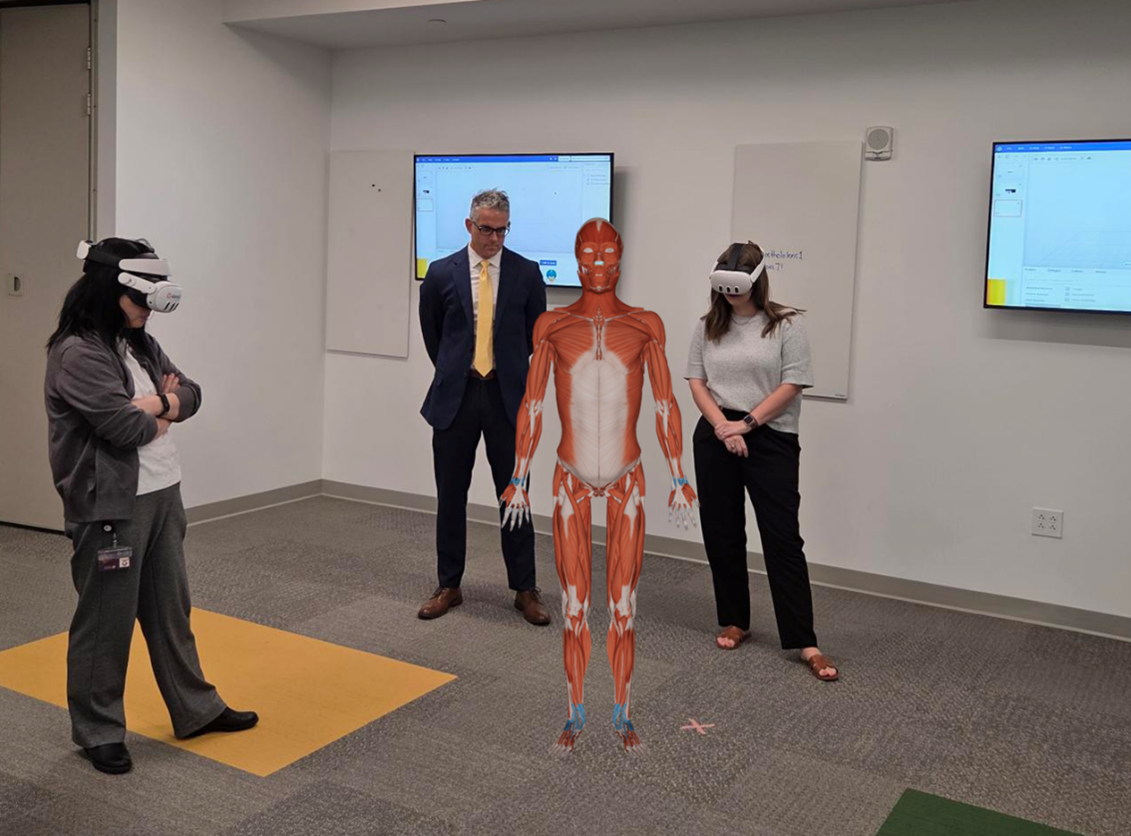
Duquesne University Nasuti College of Osteopathic Medicine – Photo courtesy of Duquesne University
TL;DR: Duquesne University uses HoloAnatomy®, a 3D anatomy software and virtual anatomy lab, to complement dissection through immersive XR learning. Students explore complex structures together in shared holographic spaces, gaining confidence and retention through active engagement
Integrating XR to Reinforce Structure-Function Learning
At the Nasuti College of Osteopathic Medicine at Duquesne University, anatomy education is an important component of the curriculum. For Dr. Amanda Troy, Chair and Associate Professor of Anatomy, mastery of structure and function is foundational to osteopathic medicine. Students must not only learn the body’s anatomy, but also understand how those structures move, interact, and respond to manipulation.
“If you don’t have a good grasp of anatomy, it’s hard to understand exactly what you’re palpating” she explained, describing how osteopathic manipulative medicine depends on deep structural insight.
Achieving that depth of understanding is challenging with limited dissection access, rising costs, and static 2D resources. Seeking a new way to help students see and retain complex relationships, Duquesne turned to a virtual anatomy lab powered by HoloAnatomy® from AlensiaXR.
From Dissection to Immersion
Duquesne still utilizes traditional dissection, but HoloAnatomy now powers what Dr. Troy calls their “second pass of anatomy.” After completing dissection work, students step into the HoloAnatomy Lab with XR headsets, where 3D holographic models bring human structure vividly to life.
“HoloAnatomy affords us the opportunity to get students into the lab and see these 3D holograms while still working in groups and learning to communicate with colleagues.”
This collaborative environment allows both students and faculty to explore together, reinforcing teamwork and spatial reasoning, without the mess and prep of traditional labs. “It’s a little cleaner than the gross lab”, a difference students appreciate after the demands of traditional dissection.
Empowering Faculty to Create Connected Learning
When Duquesne adopted HoloAnatomy, Dr. Troy had the unique advantage of designing her courses alongside the new technology. “I was able to take my lectures and set them next to the HoloAnatomy software and start building labs that correlated directly,” she said. “Those little things that sometimes get lost in donors. I can enlarge them and make sure they show up better for students.”
Dr. Troy built interactive XR lessons that align with her lectures, allowing students to visualize relationships that are otherwise hidden in dissection. She integrates ultrasound, radiology, and histology directly into the holographic environment, helping students connect structure, function, and pathology in a single, cohesive view.
The result is a curriculum where anatomy lecture and lab reinforce one another, using both dissection and immersive XR to help students revisit, clarify, and apply anatomical relationships.
Engaging Students Through Play and Challenge
Dr. Troy’s team uses HoloAnatomy to make anatomy engaging and competitive.
“We’ve done case challenges where lab groups compete to solve board-style questions using holograms. They have to figure out what they’re looking at, apply what they’re seeing to the question, and yes, there’s usually candy for the winning team.”
Labs also simulate real-world problem solving. Students collaborate on clinical cases, integrating embryology and OMM (Osteopathic Manipulative Medicine) concepts directly within the holographic environment. “It’s been a really great resource, especially because you can put images behind the hologram. MRIs, ultrasounds, histology slides. Whatever supports the lesson.”
Strengthening Retention and Confidence
By starting with dissection and then returning to holographic anatomy to reinforce what they’ve learned, Duquesne’s program helps students build lasting confidence.
“Those who experienced HoloAnatomy before going into gross lab came in with a stronger foundation and more confidence in their dissections. Others who come to XR after dissection often say, ‘Oh, that’s the relationship they were talking about!”
Faculty have also noticed that students retain more information. “They found they actually remember more than they think they do,” she said. “It’s learning by doing, just in a cleaner, more flexible format.”
Advice for Other Programs
For educators considering XR adoption, Dr. Troy offers three practical recommendations:
Select mixed reality tools that include pass-through vision, allowing users to see both the holograms and the physical room.
Encourage faculty to explore the technology firsthand so they can better understand its teaching potential.
Engage stakeholders early by inviting AlensiaXR to host on-campus demonstrations that let decision-makers experience the technology in action.
Get Your Free HoloAnatomy® eBook
Explore how leading institutions modernize anatomy learning with XR and 3D anatomy software.
