
Research findings.
Numerous peer-reviewed studies and meta-analyses conclude that spatial learning—including Extended Reality (XR) modalities such as Mixed Reality (MR)—accelerates training speed and enhances long-term knowledge retention.
Multiple HoloAnatomy® studies support these findings by reporting stronger comprehension, higher engagement, and equal or better assessment outcomes compared to traditional cadaver-only methods.
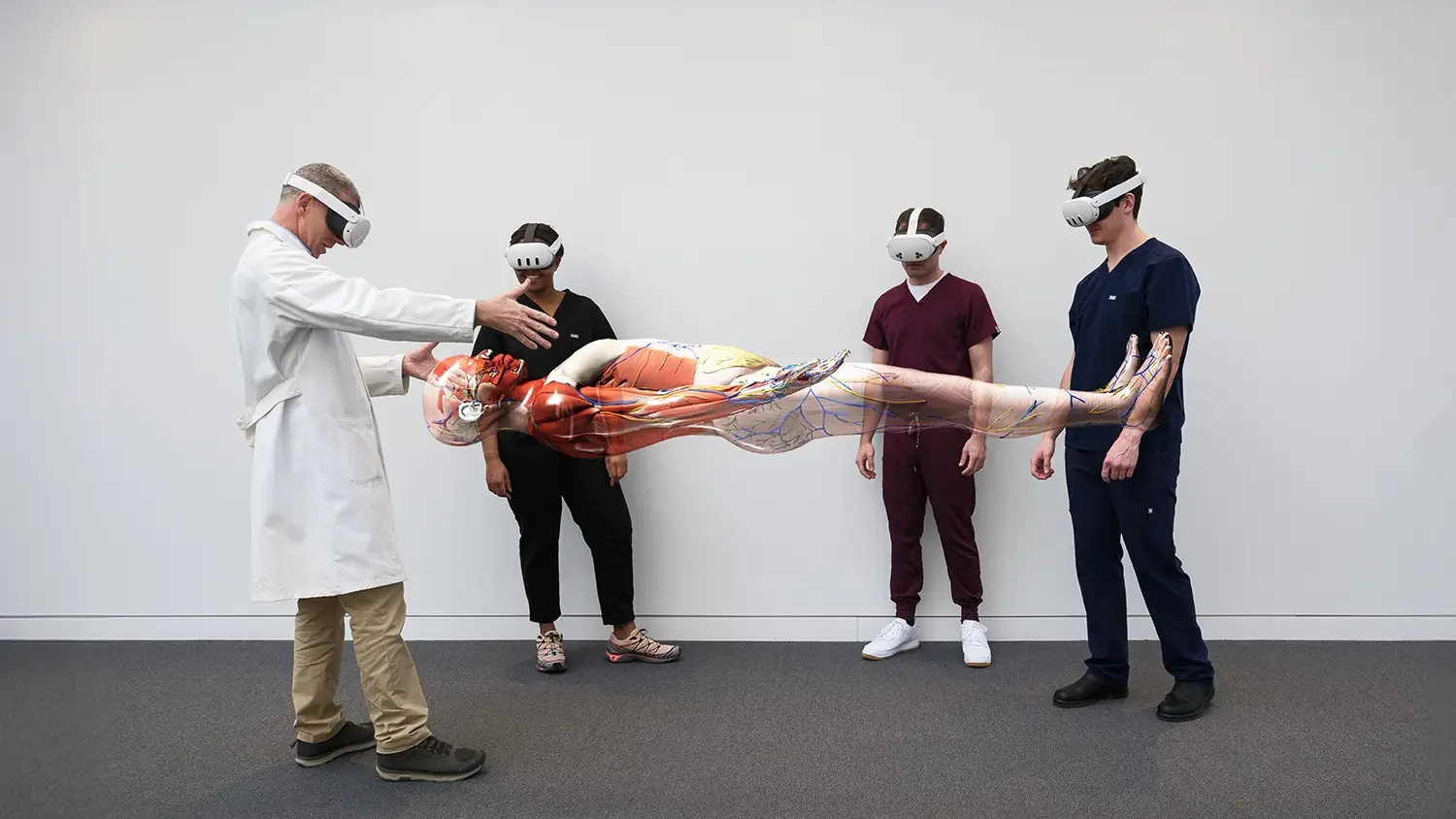
Key findings at a glance.
Studies conducted on institutions using HoloAnatomy® reported:
Reduced study time by up to one-third without sacrificing learning outcomes.
Retention increased by up to 40% compared to dissection-only cohorts.
Boosted engagement across behavioral, emotional, and cognitive dimensions.
Stronger comprehension and confidence when supplementing dissection
Research articles and summaries.
Peer-reviewed studies and meta analyses.
The following studies and systematic reviews evaluated the positive impact of spatial immersive learning compared to traditional methods:
"The Impact of Virtual Reality Immersive Learning on Student Retention Rates: A Pedagogical Review" (2026)
This study tracked higher education metrics in multiple countries over a decade. Researchers found that spatial learning yielded a significant positive correlation with knowledge retention, spatial understanding, and long-term memory consolidation compared to traditional methods.
"A systematic review of the experimental studies on the use of mixed reality in higher education" (2023)
This systematic review examined empirical research on headset-based and mobile mixed reality. It concluded that MR significantly enhances the visualization and conceptual understanding of 3D layered objects—most notably in medical anatomy and engineering education.
"Cognitive load, extended reality, and visuospatial abilities in physical science education" (2026)
This study reviewed 44 empirical papers investigating the link between spatial presence and memory. It concluded that highly immersive spatial computing reduces cognitive load, allowing the brain to process information faster and form more enduring mental representations.
"The PwC Augmented and Virtual Reality Soft Skills Training Study"
A seminal enterprise study found that learners trained in VR/MR environments completed training up to 4x faster than classroom learners and 1.5x faster than e-learners. The use of XR headsets drastically reduced distractions, leading to maximized focus and rapid time-to-proficiency.
"Acquisition and retention of spatial knowledge through virtual reality" (2023)
Published in the International Journal of Human-Computer Studies, this study proved that spatial training using immersive headsets allowed participants to construct more accurate mental maps of distance estimations and object-to-object relations, leading to superior recall retention during follow-up testing two weeks later.
"Immersive and interactive virtual reality to improve learning and retention of neuroanatomy"
This randomized controlled study looked at medical students learning complex neural pathways. The integration of 3D spatial models directly improved long-term knowledge retention, enhanced participants' understanding of cross-sections, and drastically reduced "neurophobia" (the fear of learning complex anatomy) compared to 2D slides.
"Enhancing learning and retention with distinctive virtual reality environments" (2022)
This study tracked how contextual environmental cues in spatial computing enhance memory recall. It established that the brain creates "spatial hooks" within immersive environments, and that the knowledge acquired via these spatial contexts successfully transfers to physical, non-VR settings.
Transforming Anatomy Education with Mixed Reality
A year-long study at Jagiellonian University Medical College integrated HoloAnatomy into first-year anatomy courses. 98% of students participated, with results showing noteworthy positive perceptions. Students reported that mixed-reality sessions improved their understanding of anatomical structures and spatial relationships, were easy to use, and supported preparation for cadaveric dissection. Most favored a hybrid model, using MR alongside traditional methods.
-
98.8% found HoloAnatomy easy to use.
97.6% reported improved understanding of regional and systemic anatomy.
95-100% could identify anatomical structures after MR sessions.
90.6% felt better prepared for dissection.
71.8% preferred a hybrid model combining MR with labs
Comparing Learning Retention Using Mixed Reality to Supplement Dissection
This study was conducted to evaluate student impressions of learning anatomy with mixed-reality and compare long-term information retention of female breast anatomy between students who learned with a mixed-reality supplement and their classmates who dissected cadavers. Students using HoloAnatomy retained information 40% better eight months later and reported MR was easier for teamwork.
-
METHODS:
In Part 1, 38 first-year medical student volunteers, randomly divided into two groups, completed a mixed-reality module and cadaveric dissection on the female breast in a counterbalanced design. Participants also completed post quizzes and surveys. Part 2 was a non-randomized controlled trial, 8-months after completing Part 1 and 6-months after a final exam on this content. The performance of twenty-two
Part 1 participants and 129 of their classmates, who only dissected, was compared on a delayed post-quiz. Wilcoxon signed-rank test, Mann-Whitney U test, and 95% confidence intervals were used to analyze the data. Results: In Part 1, the Wilcoxon signed-rank test determined that participants expressed significantly more positive responses to mixed-reality and found mixed-reality easier for learning and teamwork. In Part 2, the Mann-Whitney U test found mixed-reality participants scored significantly higher on a delayed-post quiz than their classmates who only dissected (U = 928, p < .009).
CONCLUSIONS:
This study suggests that medical students may prefer mixed-reality and that it may be an effective modality for learning breast anatomy while facilitating teamwork. Results also suggest that supplementing cadaveric dissection with mixed-reality may improve long-term retention for at least one anatomical topic. It is recommended that similar studies evaluate a larger sample and additional anatomical regions to determine the generalizability of these findings.
Assessment of Mixed-Reality Technology Use in Remote Online Anatomy Education
The coronavirus (COVID-19) pandemic presented education challenges worldwide, particularly in medical schools relying on cadaver-based dissection. Mixed-reality (MR) technology offered new possibilities for anatomy education. This study used survey responses from first-year medical students Case Western Reserve University (CWRU) to evaluate the initial experience of an anatomy lesson delivered remotely using teleconferencing and mixed-reality. 84% of students believed anatomy can be effectively learned remotely via MR, with 81% citing advantages like flexibility and study space.
Mixed reality as a time-efficient alternative to cadaveric dissection
The goal of this study was to determine whether HoloAnatomy represents an effective and time-efficient modality to learn anatomy when compared to traditional cadaveric dissection. Students required ~4.6 hours with HoloAnatomy vs. 7.3 hours (1/3 less) in cadaver lab, achieving similar exam results.
Mixed Reality Anatomy Using Microsoft HoloLens and Cadaveric Dissection
In this randomized controlled trial, researchers looked at the effectiveness of mixed reality to teach musculoskeletal anomy to medical students compared with traditional cadaveric dissection. Exam scores were statistically equivalent between MR and cadaver groups, validating HoloAnatomy as an effective alternative.
Student Engagement Using Mixed-Reality for Osteopathic Medical Students
Mixed reality increased engagement (curiosity, participation, responsiveness) and reduced signs of disengagement compared to traditional methods.
Cadaver vs. Microsoft HoloLens: A Comparison of Educational Outcomes of a Breast Anatomy Module
A 3D anatomical model of the breast was developed and integrated into a dynamic, educational module on HoloLens. 38 first-year medical students were recruited and divided into two groups: one participated in the HL module prior to dissection, and the second dissected the cadaveric breast prior to the HL module. Results showed that scores on comprehension-based questions significantly improved after the HL module (p=0.0209). Students also appeared to react more positively to the HL module than the dissection, regardless of which they were presented with first (p=0.0008).
While these studies suggest meaningful benefits of mixed-reality in anatomy education, most were conducted with limited sample sizes and within specific curricular contexts. Results may vary by institution, content area, and implementation.
HoloAnatomy® studies.
The following studies were conducted at institutions using HoloAnatomy in their classrooms:
From research to practice.
Studies show that learning anatomy with mixed-reality can reduce study time, improve retention, and boost engagement. HoloAnatomy® and the .NEXT™ platform bring these benefits to today’s classrooms with immersive learning built for faculty and students.
Ready to elevate your program with research-backed immersive learning?
Let’s talk about how HoloAnatomy® and the .NEXT™ spatial learning platform can support better learning outcomes in your classroom.